Choosing a wood pellet wholesale supplier is one of the most important decisions a reseller, distributor or garden-centre chain makes each year: your customers judge you on every bag, and a supplier who misses a delivery in November costs you the season. Price matters, but consistency, documents, logistics and contract terms matter just as much. This guide sets out what to ask before you sign, with a ready-to-use checklist.
What a reseller needs from a wood pellet wholesale supplier
Whether you sell 10 pallets a month or several trucks a week, the requirements are the same:
- Consistent quality from batch to batch, so customers do not notice a change in ash or dust.
- Documentation you can pass on: batch data sheets, delivery notes and, from the end of 2026, the information needed under EU deforestation rules.
- Reliable logistics: standard pallet formats, full truckloads on agreed dates, and clear delivery terms.
- Commercial clarity: prices that state what is included, payment terms, and how volume commitments work across the season.
Quality and consistency: what to ask for
Batch data sheet
Ask for an analysis of every batch, stating the standard and class (for example ISO 17225-2 A1 or A2) with moisture, ash, durability, fines, calorific value and bulk density, plus the test methods and date. Compare several sheets over time: a good wood pellet wholesale supplier shows little variation.
Certification claims
If you sell pellets under a certification seal, verify it yourself. The ENplus scheme says a genuine seal always carries the certified company’s ID number and, on pellet bags, the quality class, and that both must match the company named on the bag or delivery note (ENplus fraud guidance, January 2024). DINplus certificates can be checked in DIN CERTCO’s database. A supplier without these certificates should say so plainly. 4 Wood Lda, for example, is not ENplus or DINplus certified: we sell pellets to the A1 and A2 quality classes of ISO 17225-2 with a batch data sheet.
Samples and test deliveries
Before committing to a season, order a first pallet or a small load, test it in the appliances your customers use and check how the bags travel.
Logistics: formats, loads and lead times
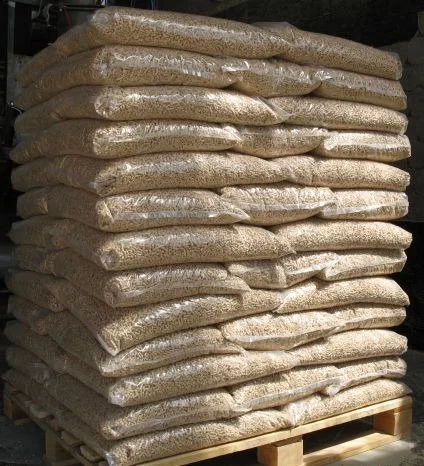
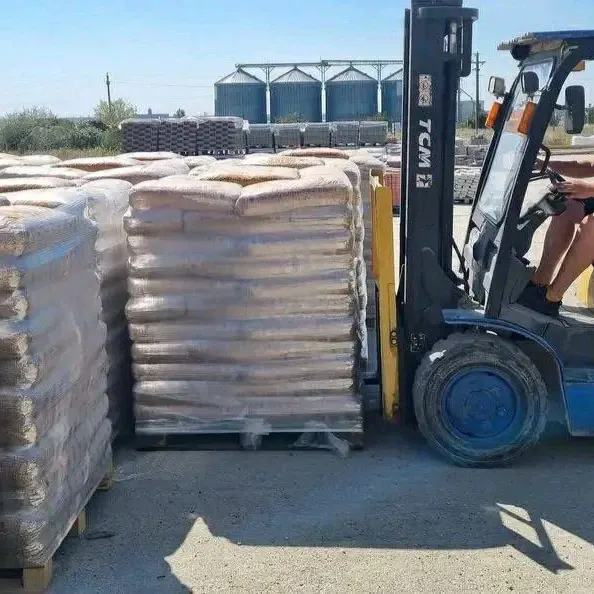
Ask which units the supplier works with and how they are loaded. Our standard formats are pallets of 66 bags of 15 kg, 1 t big bags and full truckloads of 24 pallets; see the bulk and truckload range. Other questions:
- What is the lead time in October compared with May?
- Can deliveries be scheduled as call-offs through the season?
- Can different products be combined on one truck, and on what terms?
- Which countries do you deliver to, and how? (We ship to Portugal, the rest of Europe and the UAE.)

Incoterms: who pays, who carries the risk
International pellet deals are usually quoted under an Incoterms 2020 rule. The rule decides where risk passes from seller to buyer and who books the freight, so two quotes with different rules are not comparable. Summary based on DHL’s Incoterms 2020 guide:
| Rule | Where risk passes to the buyer | Who arranges main transport | Typical use for pellets |
|---|---|---|---|
| EXW | Goods made available at the seller’s premises | Buyer | Buyers with their own trucks |
| FCA | Goods handed to the buyer’s carrier at the named place | Buyer | Buyer’s haulier collects; seller loads |
| CPT | Goods handed to the first carrier | Seller | Seller books freight, buyer bears transit risk |
| DAP | Goods ready for unloading at destination | Seller | Delivered truckloads to a reseller’s yard |
| DDP | Goods cleared for import, ready for unloading | Seller | Seller handles import duties and taxes |
| FOB / CIF | Goods on board the vessel at the port of shipment | Buyer (FOB) / Seller (CIF) | Sea shipments only |
For road deliveries inside Europe, FCA and DAP are the most practical. Avoid using FOB or CIF for trucks: they are designed for sea and inland waterway transport.
Compliance: the EU Deforestation Regulation
Wood is one of the commodities covered by the EUDR. According to the European Commission (January 2026), it applies from 30 December 2026 for large and medium-sized operators and for traders, and from 30 June 2027 for micro and small enterprises. Downstream operators and traders no longer file their own due diligence statements but must keep the reference number of the original statement, and all operators must keep records of suppliers and customers for five years. Ask your wood pellet wholesale supplier now how it will pass on that information, and check your product codes in Annex I.
Private label and bag design
Many distributors want pellets in their own bags. Ask about minimum print runs, lead times for new bag designs and who is responsible for the content of the label. If the bag will carry a certification seal, the scheme’s own rules apply: ENplus, for instance, requires an approved bag design, the certified company’s details, diameter and net weight, storage and use warnings in the market’s languages, and a serial number printed during bagging (ENplus bag design brochure, 2026). Those points are good practice even on uncertified bags.
Checklist: 10 questions for a wood pellet wholesale supplier
- Which standard and quality class do you supply, and can I see recent batch data sheets?
- Which certificates do you hold, and how can I verify them?
- What raw material do you use (softwood, hardwood, mix)?
- What formats and pallet configurations do you offer?
- What are lead times in peak season?
- Can I schedule call-offs across the season?
- Which Incoterms rule does your price use, and what exactly is included?
- What are the payment terms?
- How will you provide EUDR information from December 2026?
- Do you offer private-label bags, and what are the minimums?
On price, remember that format and volume drive cost: in Spain, AVEBIOM’s Q2 2026 index put pallets of bags at €372.29 per tonne and bulk by tipper at €352.28, VAT included. Our own prices for heating pellets are always on request.
FAQ
What is the minimum order from a wood pellet wholesale supplier?
It varies. Many resellers start with a few pallets or one truck; regular programmes are usually built on full 24-pallet truckloads.
Should I buy under EXW or DAP?
If you have reliable haulage at good rates, EXW or FCA can work. If not, DAP gives you a delivered price and leaves transport to the supplier.
Is ENplus certification required to resell pellets?
Not by law, but some markets and customers expect it. If you sell certified pellets, verify the certificate and follow the scheme’s rules; if not, sell on the ISO class and data sheet.
Do you supply resellers outside Portugal?
Yes. 4 Wood Lda ships to Portugal, the rest of Europe and the UAE.
A good supply relationship is built on clear specifications, honest documentation and logistics that work in the busiest weeks of the year. If you are looking for a wood pellet wholesale supplier for next season, request a quote or message us on WhatsApp (+351 966 799 273) with your volumes and destination.
Sources and references
- Incoterms 2020 rules DHL Freight, accessed November 2026
- Delay until December 2026 and other developments in the implementation of the EUDR European Commission – Access2Markets, January 2026
- How to detect fraud? ENplus, January 2024
- Brochure: bag design approval ENplus, February 2026
- DINplus Wood Pellets Class A1 DIN CERTCO, 2026
- Índice de precios del pellet de madera para uso doméstico en España, 2T 2026 AVEBIOM, July 2026