The European wood pellet market entered the 2026–27 heating season after a record year for production and with prices rising again in most countries. For households this means planning purchases earlier; for resellers and distributors it means watching supply, import flows and new rules more closely than before. This article summarises the latest published data on consumption, production, imports, prices and policy, and what they mean for buyers in Portugal and across Europe.
The European wood pellet market in figures
The most complete picture comes from Bioenergy Europe’s Pellet Statistical Report, presented in June 2026 with data for 2025:
| Indicator (2025) | Value |
|---|---|
| Global pellet production | 53.5 million tonnes (+10% on 2024) |
| Global pellet consumption | 51.5 million tonnes (all-time high) |
| Europe’s share of global demand | about 70% (industrial and small-scale combined) |
| Europe’s share of global production | 45% |
| European production (excl. Belarus and Russia) | 24.1 million tonnes (+10%, a regional record) |
| European small-scale consumption | more than 19 million tonnes (record) |
| European residential consumption | 15.3 million tonnes (+5%) |
| Households heated with pellet appliances | more than 6.5 million |
Two facts stand out about the European wood pellet market. First, Europe consumes far more pellets than it produces, so it depends on imports. Second, growth is now driven by heat, not only by power stations: residential and small commercial use set new records.
Who uses the pellets: stoves in the south, boilers in the north
According to Bioenergy Europe, Italy has the largest installed base, with more than 2.3 million pellet appliances, followed by France with about 2 million, mostly room stoves in both cases. In Austria, Germany, Poland, Sweden and Czechia, pellet boilers used as the main central heating system are more common, which means a higher consumption per household. Public support schemes in Austria and Poland led to a near-record number of households switching to modern pellet boilers.
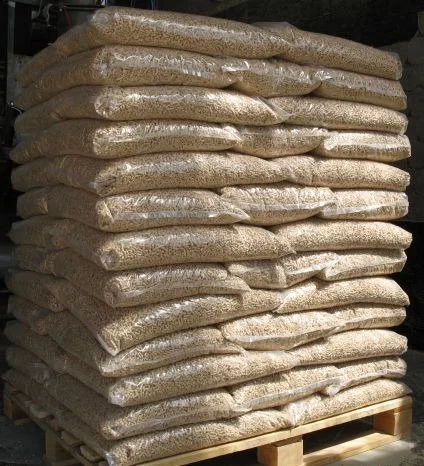
For suppliers this matters because the two segments buy differently: stove markets want 15 kg bags on pallets in autumn, boiler markets increasingly want bulk deliveries spread across the year.
Imports and supply: life after Russia and Belarus
Since the restrictions on Russian and Belarusian wood products, European buyers have relied more on other suppliers, including the United States and Canada. Citing the USDA’s EU Wood Pellets Annual report, Wood Business Portal (August 2026) reported that EU consumption is expected to grow by roughly 500,000 tonnes in 2026, with imports reaching about 4.8 million tonnes. Biomass Magazine (July 2026) summarised the same report as forecasting a 2% rise in EU consumption this year and a partial recovery of imports. Month to month the flows are volatile: EU imports fell 9% in June 2026 while the average import price rose about 6%.
Where Portugal fits
Portugal is primarily an exporting country. A barometer of the Portuguese pellet industry published in February 2024 estimated national production at about 750,000 tonnes in 2022, with roughly two-thirds exported. The United Kingdom and Denmark were the largest destinations for industrial pellets, while exports of premium heating pellets grew mainly to France, Italy and Belgium. These are the latest detailed national figures we could verify; more recent official statistics for Portugal were not available at the time of writing (November 2026).

Prices across the European wood pellet market
After the 2022 spike and the falls of 2023–24, prices rose again in 2026. Two national benchmarks illustrate the trend:
| Country | Benchmark | Latest value |
|---|---|---|
| Germany | DEPI average, 6 t bulk delivery incl. VAT | €464.61/t (October 2026), +2.3% month on month |
| Spain | AVEBIOM, pallet of bags incl. 21% VAT | €372.29/t (Q2 2026), +12.8% year on year |
| Spain | AVEBIOM, 15 kg bag incl. VAT | €5.67 (Q2 2026), +10.3% year on year |
The German Pellet Institute DEPI linked the autumn increases to tight raw-material supply: weak demand for sawn timber led sawmills to cut output, reducing the sawdust available for pellets. Even so, DEPI calculated that pellets remained about 45% cheaper than heating oil and about 21% cheaper than natural gas in October 2026. In Spain, AVEBIOM’s index showed bagged pellets rising faster than bulk over the year.
Policy: heating strategy and deforestation rules
- Heating and cooling: Bioenergy Europe notes that renewables supply around one third of household heating in EU buildings, that natural gas still dominates, and that a new EU Heating and Cooling Strategy is expected in 2026.
- EU Deforestation Regulation (EUDR): wood is one of the seven commodities covered. After two postponements, the European Commission states that it applies from 30 December 2026 for large and medium-sized operators and traders, and from 30 June 2027 for micro and small enterprises (Regulation (EU) 2025/2650). Check whether your product codes are listed in Annex I and what documentation your supplier will provide.
What this means for buyers and resellers
- Buy earlier. With demand at record levels and supply tied to sawmill activity, autumn shortages and price jumps are likely to recur.
- Diversify suppliers. Iberian producers sit close to Atlantic and Mediterranean markets and offer an alternative to long-haul imports.
- Ask for documents. A batch data sheet for quality and, from the end of 2026, the information you need under the EUDR.
- Use full loads. On cross-border routes, a full truck keeps freight per tonne under control.
4 Wood Lda, in Pedrógão Grande, supplies heating pellets to the A1 and A2 classes of ISO 17225-2 on pallets, in 1 t big bags and in full 24-pallet truckloads to Portugal, the rest of Europe and the UAE.
Outlook: what to watch in the European wood pellet market
Four indicators will shape the European wood pellet market over the next twelve months. Sawmill output, because it sets the volume of sawdust available. Winter temperatures, because a cold season drains stocks and lifts prices for the following year. Import flows from North America, which balance the gap between European production and demand. And the practical roll-out of the EUDR at the end of 2026, which will add paperwork for operators and traders. None of these points to a sharp fall in prices, so the safest approach for resellers is to secure part of the season’s volume early and keep some flexibility for the rest.
FAQ
How big is the European wood pellet market?
Europe accounts for about 70% of global pellet demand. Global consumption reached 51.5 million tonnes in 2025, according to Bioenergy Europe, and European production was 24.1 million tonnes.
Will pellet prices in Europe fall in 2027?
Nobody can say for sure. Prices depend on the coming winters, sawmill output and energy markets. The latest benchmarks (Germany October 2026, Spain Q2 2026) were rising.
Where does Europe import pellets from?
Since restrictions on Russian and Belarusian wood products, more pellets come from other origins, including the United States and Canada, and from intra-European trade such as Portuguese exports.
Does the EUDR apply to wood pellets?
Wood is a covered commodity. Check Annex I of the regulation for your exact product codes and ask your supplier how it will provide the required information.
The European wood pellet market is growing, tighter and more regulated than a few years ago, which rewards buyers who plan ahead and work with reliable suppliers. If you are planning your volumes for the next season, request a quote or contact us on WhatsApp (+351 966 799 273).
Sources and references
- Global pellet market hits new high as Europe weighs its clean heat options Bioenergy Europe, June 2026
- EU wood pellet imports fall 9% in June as import prices rise Wood Business Portal, August 2026
- Report: Increased residential demand to boost EU wood pellet consumption in 2026 Biomass Magazine, July 2026
- Pelletpreis im Oktober steigt weniger stark DEPI – Deutsches Pelletinstitut, October 2026
- Índice de precios del pellet de madera para uso doméstico en España, 2T 2026 AVEBIOM, July 2026
- Delay until December 2026 and other developments in the implementation of the EUDR European Commission – Access2Markets, January 2026
- Barómetro anual sobre a indústria dos pellets em Portugal Indústria e Ambiente, February 2024