
Knowing how to store wood pellets properly protects both your money and your stove: pellets that pick up moisture swell, crumble into dust and give less heat, and fines block augers and burn pots. Good storage is simple, but it differs between a household with a few pallets of bags, a boiler owner with a silo and a reseller with a warehouse. This guide covers all three, including the safety rules for enclosed pellet stores that many people overlook.
Why storage matters: moisture, fines and heat output
Quality heating pellets leave the factory dry. The ENplus handbook, for example, limits moisture to 10% as delivered and fines to 0.5% when bags are filled. Your job is to keep them that way. Pellets are compressed wood with no binder other than the wood’s own lignin, so water undoes the pressing: they swell, split and turn back into sawdust. Damp pellets also burn less efficiently and leave more residue.
The other enemy is mechanical damage. Every time pellets are dropped, thrown or dragged, a little more dust is produced. That dust ends up at the bottom of the bag, the hopper or the silo, where it can disturb feeding and combustion.
How to store wood pellets at home: bags on pallets
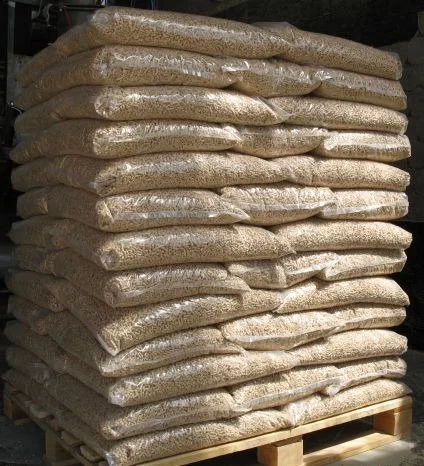
Most households buy a pallet of 15 kg bags. Here is how to store wood pellets in bags so they stay in perfect condition all season:
- Choose a dry, covered place: a garage, shed, cellar without damp or a covered porch protected from driving rain.
- Keep the bags off the ground: leave them on the pallet or put them on wooden boards. Concrete floors draw up moisture.
- Leave a gap to the walls: outside walls can be cold and wet in winter, and condensation forms on them.
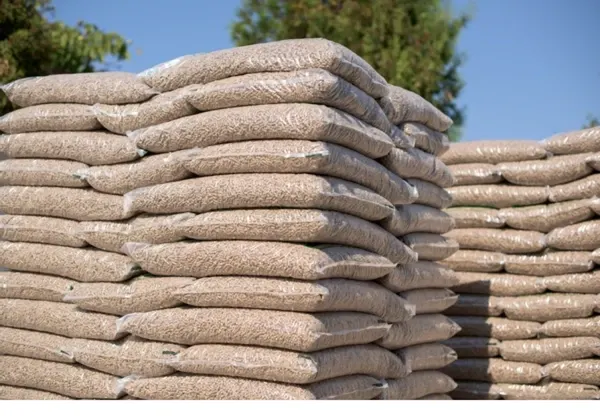
- Leave the shrink-wrap on until you need the bags: it protects them from dust and splashes. If you store outdoors under a roof, add a breathable cover rather than airtight plastic that traps condensation.
- Keep them away from heat and flames: do not stack bags next to the stove or a boiler flue.
- Handle with care: lift and place bags rather than throwing them, and open one bag at a time.
- Use the oldest bags first: if you buy more during the season, put new pallets behind the old ones.

Big bags, silos and pellet storage rooms
If you heat with a pellet boiler, you probably empty big bags into a hopper or have pellets delivered into a fabric silo or a dedicated storage room. Austrian association proPellets publishes detailed storage recommendations based on ISO 20023. The main points:
- The store must keep out moisture and rain during storage and filling, and condensation must be prevented.
- Storage rooms with a sloped floor need an incline of 40° ± 5° and a smooth, abrasion-resistant surface.
- Ventilation openings must lead outdoors so the store exchanges air with the outside.
- Switch off the heating system before a bulk delivery fills the store, as signposted at the filling connection.
- Remove fines at the intervals set by the boiler and discharge-system manufacturer; large stores should be emptied and cleaned completely at least every two years.
- Fabric silos must keep the clearances to walls and ceiling given by the manufacturer and must not rub against the walls.
| Storage option | Suits | Key points |
|---|---|---|
| Pallet of 15 kg bags | Stoves and inserts | Dry, off the floor, away from walls and heat |
| 1 t big bag | Boilers with hopper, small industry | Under cover, lifting equipment, empty in one go |
| Fabric silo | Pellet boilers | Clearances, venting to outside, regular emptying of fines |
| Storage room | Pellet boilers with large consumption | Sloped floor, outside ventilation, CO warning sign |
| Warehouse | Resellers, distributors | Roof and floor dry, first in first out, batch records |
Safety: carbon monoxide in enclosed pellet stores
This is the part of how to store wood pellets that is most often ignored. Stored pellets can release carbon monoxide (CO). The German commission KAN explains in its KANBrief 2/2019 that natural fatty acids in wood react with oxygen in closed stores, and that mechanical stress during transport and filling increases CO formation. It cites 13 documented fatal accidents between 2002 and 2011 in ships’ holds, bulk stores, silos and residential stores. The Bioenergy Association of New Zealand, sharing guidance from the UK’s HSE, also warns that unventilated pellet stores can deplete oxygen and should be assessed as confined spaces.
proPellets’ rules for entering a store:
- Ventilate for at least 15 minutes before entering and keep ventilating while inside.
- Switch off the pellet heating first.
- Enter only with a CO detector and with a second person outside.
- Fit a warning sign on the door: possible dangerous CO levels, no unauthorised entry, no smoking or ignition sources.
Bags stored in a ventilated garage are a much lower risk, but the principle is the same: do not keep large quantities of pellets in a small, closed, unventilated room where people spend time.
How to store wood pellets in a warehouse
For resellers and distributors, storage protects the product and the margin. A practical routine:
- Inspect on arrival: check the shrink-wrap, look for torn or wet bags, and file the batch data sheet with the delivery note.
- Dry building: sound roof, no water ingress at doors, pallets on a dry floor.
- First in, first out: label pallets with the arrival date and batch, and pick the oldest first.
- Careful handling: forklift drivers should avoid puncturing bags; damaged bags lose quality fast.
- Fire prevention: keep ignition sources away and keep dust under control. proPellets notes that large stores require mechanical ventilation suitable for an explosive-dust zone (Zone 22).
4 Wood Lda supplies heating pellets on shrink-wrapped pallets of 66 bags of 15 kg, in 1 t big bags and in full truckloads, each with a batch data sheet.
FAQ
Can I store wood pellets outside?
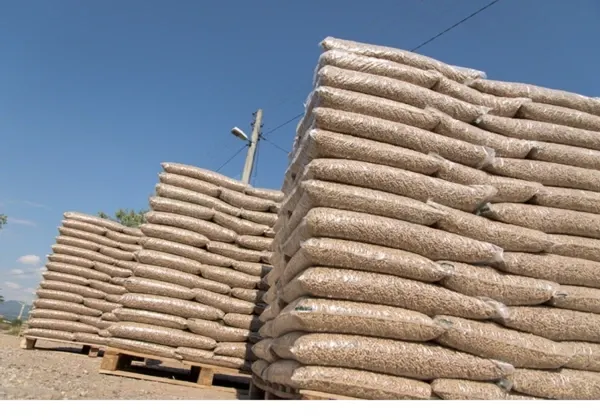
Only under a roof and off the ground, with a breathable cover. Rain, standing water and condensation will ruin the bottom bags.
How long can pellets be stored?
Kept dry and undamaged, pellets keep for a long time; the risk is moisture and handling, not age. Still, use the oldest stock first.
How do I know if pellets have absorbed moisture?
They look dull, feel soft, break without a snap and leave more dust. Swollen or crumbling pellets should not be burned in a stove.
Is it dangerous to store pellets in a basement?
Bags in a ventilated, dry space are low risk. Enclosed bulk stores need ventilation to the outside, a CO warning sign and the entry rules described above.
Once you know how to store wood pellets, a full season’s supply is easy to keep in good condition. If you are planning your next delivery of pallets, big bags or a truck, request a quote or message us on WhatsApp (+351 966 799 273).
Sources and references
- Empfehlungen zur Lagerung von Holzpellets proPellets Austria, 2025
- Safe storage of wood pellets (KANBrief 2/19) KAN – Kommission Arbeitsschutz und Normung, 2019
- Report: Safe storage of wood pellet and wood chip fuel Bioenergy Association of New Zealand / HSE, accessed November 2026
- ENplus Handbook Part 3 – Pellet quality requirements (v3.0) European Pellet Council / ENplus, August 2015