Lump charcoal vs briquettes is one of the first decisions any restaurant, grill house or charcoal reseller has to make, and the right answer depends less on habit than on how you actually cook. A churrasqueira that sears chicken and picanha for four hours at lunch has very different needs from a weekend customer who wants a bag that lights easily and lasts through one family barbecue. This guide compares the two fuels on the points that matter to a buyer: heat, burn time, ash, smoke and the real cost per hour of cooking.
How lump charcoal and charcoal briquettes are made
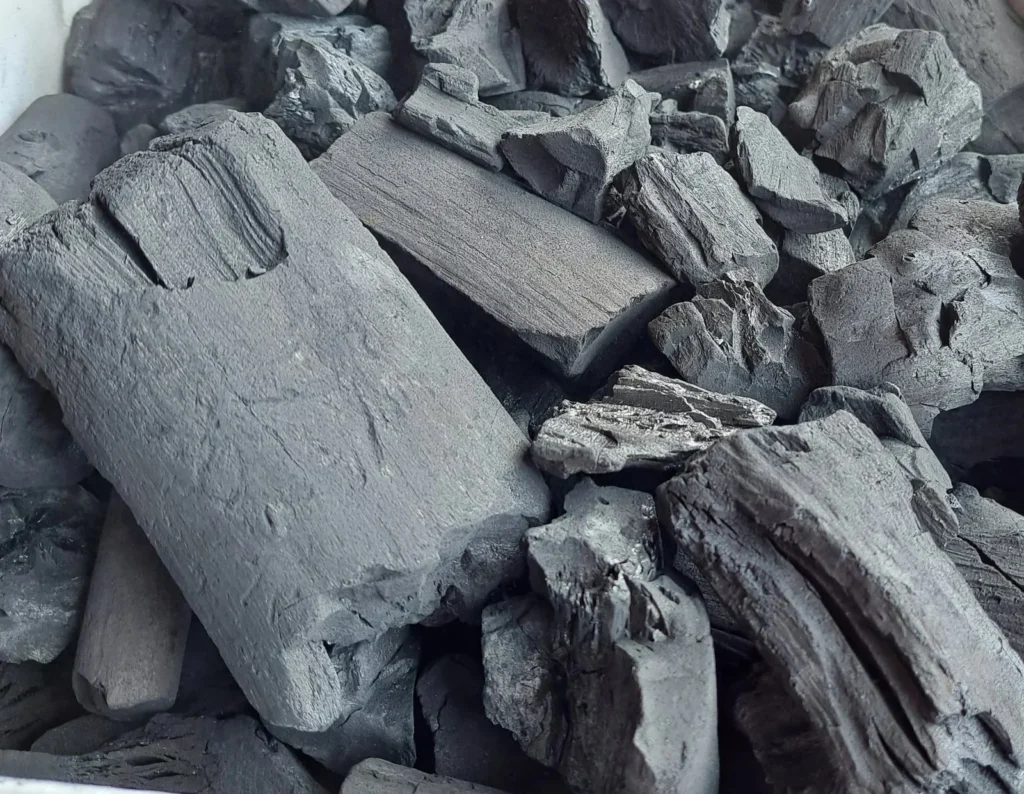
Lump charcoal is wood that has been carbonised in a kiln with limited oxygen. Water and most volatile compounds are driven off, and what remains keeps the shape of the original pieces of wood. Good hardwood lump is light, rings when pieces knock together and breaks with a shiny, glassy surface.
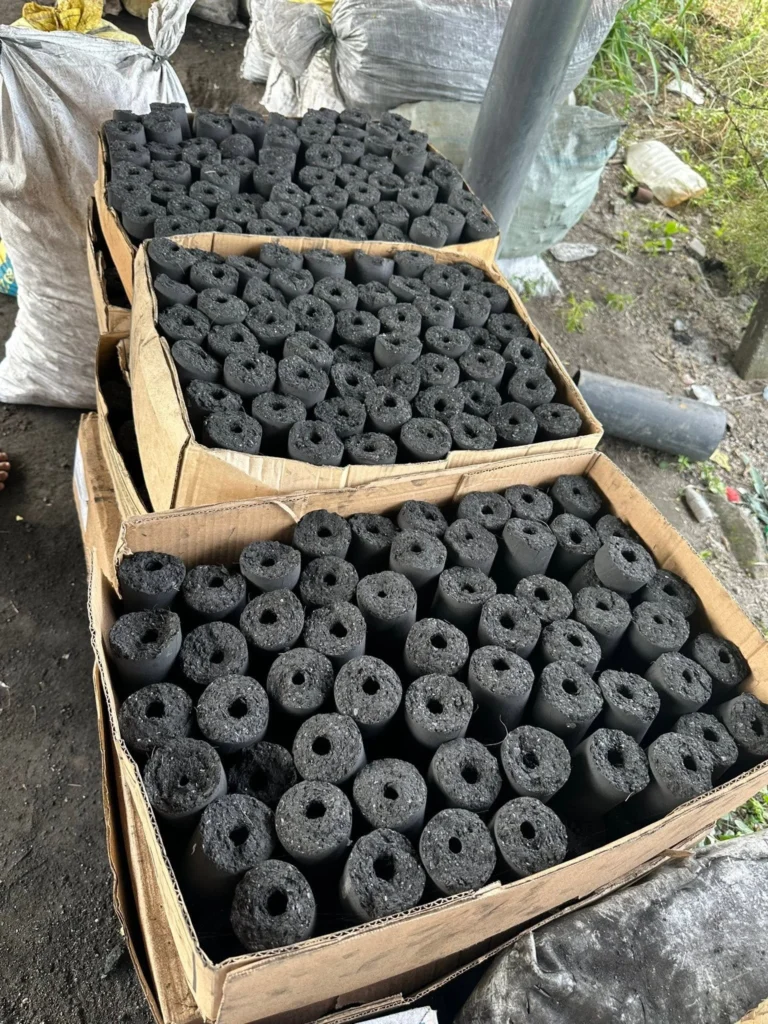
Charcoal briquettes are made from charcoal fines (the small particles and dust left over from production and handling) that are ground, mixed with a binder such as starch, pressed into uniform pillows or cylinders and dried. Because the raw material is graded powder rather than whole pieces, every briquette is the same size and density, which is precisely their main selling point.
That difference in manufacture explains almost everything else: lump is closer to pure carbon and reacts quickly to air; briquettes are denser, more uniform and contain whatever the binder and mineral content add to them.
Lump charcoal vs briquettes: heat, burn time, ash and smoke
Independent laboratory data on lump charcoal vs briquettes sold in shops is rare, so a 2025 study from the University of Padua is useful. The researchers tested 15 lump charcoals and 8 charcoal briquettes bought in Italian shops, then burned them in a commercial barbecue (Mencarelli, Greco & Grigolato, Biomass Conversion and Biorefinery, 2025). Their findings match what grill cooks report from experience:
- Ten of the 15 lump samples exceeded 75% fixed carbon, while all briquettes except one stayed below 60%.
- Briquettes generally had more ash; two briquette samples exceeded 30% ash.
- Most lump samples had less than 7% moisture, while most briquettes were above 7%.
- Briquettes burned longer, with a slower burning rate, but every briquette sample produced ember temperatures below 500 °C, whereas the hottest lump sample reached around 600 °C.
| Criterion | Hardwood lump charcoal | Charcoal briquettes |
|---|---|---|
| Lighting | Fast; ready in less time | Slower; needs a chimney starter or more patience |
| Peak heat | Higher; ideal for searing | Lower but steady |
| Burn time | Shorter per kg | Longer, more even burn |
| Ash | Low with good hardwood | Higher; depends on binder and fines quality |
| Size | Irregular pieces; some fines in the bag | Uniform shape and weight |
| Control | Responds quickly to air vents | Predictable, “set and forget” |
| Best for | Grill houses, steak, fish, high-heat service | Long cooks, kettle barbecues, retail beginners |
Smoke is mostly a question of quality rather than category. Well-carbonised charcoal of either type should produce little visible smoke once lit. Most of the smoke and flare-ups at a grill come from fat dripping onto the embers: Ireland’s food safety authority notes that polycyclic aromatic hydrocarbons (PAHs) form when fat drips onto a flame and that the fuel, the cooking method and the amount of oxygen all influence how much is produced (FSAI). Under-carbonised charcoal with high volatile content, or briquettes with a poor binder, will smoke more at lighting, which is exactly what a dining room does not want.
What the EN 1860-2 standard says about each fuel
In Europe, the reference for barbecue fuel quality is EN 1860-2, whose current edition was published by CEN in June 2023 and replaced the 2005 version (EN 1860-2:2023, CEN/TC 281). It sets different limits for the two products:
- Barbecue charcoal: at least 75% fixed carbon, no more than 8% ash (dry basis) and no more than 8% total moisture.
- Barbecue charcoal briquettes: at least 60% fixed carbon and no more than 18% ash on a dry basis, as cited from the 2023 edition in a 2025 Frontiers in Energy Research paper.
The 2023 edition also distinguishes granulation for barbecue charcoal, table grill charcoal and restaurant charcoal, which is useful when you buy for a professional kitchen. The gap between the two sets of limits tells you something important: a briquette is allowed to contain more than twice as much ash as lump charcoal and still comply, so ask for a test report rather than assuming.
Cost per hour of cooking: how to compare properly
Comparing price per kilo is the most common mistake in the lump charcoal vs briquettes debate. What a kitchen really pays for is usable heat during service. A simple method works for any business:
- Weigh the fuel you load at the start of a service.
- Weigh what you add during service and what is left unburned at the end.
- Divide the kilos consumed by the hours the grill was actually cooking.
- Multiply by your delivered price per kilo, including transport.
Run the test for one full week with each fuel. Lump charcoal often uses more kilos per hour but gets the grill to temperature faster, which saves gas or labour at lighting and lets you reach searing heat with less fuel. Briquettes usually burn longer per kilo but more ash means more cleaning and, if the grill is opened often, heat that recovers more slowly. Add the time staff spend lighting, refuelling and emptying ash: in a busy restaurant, that labour can matter more than the price difference between the two fuels.
Which fuel suits which business?
Restaurants and grill houses
For churrasqueiras, steak houses and fish grills, the lump charcoal vs briquettes question usually has a clear answer: hardwood lump charcoal is usually the first choice: high heat, quick response to air and less ash in the grill. Larger, well-graded pieces matter more than brand names; a bag full of fines burns fast and clogs the grate.
Long cooks, catering and events
For smoking, slow roasting or catering where the grill must stay stable for hours with little attention, charcoal briquettes are easier to manage. Many professionals combine both: a bed of briquettes for duration and lump on top for searing.
Retailers and resellers
Supermarkets, garden centres and petrol stations sell both. Lump charcoal in 3 to 10 kg bags is the volume line in summer; briquettes appeal to customers who want an even, longer barbecue. Clear labelling of wood species and origin builds trust; independent tests have found that many bags give no wood information at all, and a 2017 WWF market survey summarised by Germany’s Thünen Institute found that about 40% of 20 products tested contained mainly subtropical or tropical wood.
Checklist: what to ask your charcoal supplier
- Is the lump charcoal hardwood, and which species?
- Can you provide a recent analysis of fixed carbon, ash and moisture against EN 1860-2?
- What share of fines (pieces under 20 mm) should I expect per bag?
- Which binder is used in the briquettes?
- Which bag sizes are available (3 kg, 5 kg, 10 kg, big bags) and how many fit on a pallet?
- Which Incoterm is the price quoted on, and what is the lead time for a full truck?
FAQ
Is lump charcoal hotter than briquettes?
Generally yes. In the 2025 Padua study, all briquettes produced ember temperatures below 500 °C, while the best lump sample reached about 600 °C. Lump is the better choice for searing and fast service.
Do briquettes last longer than lump charcoal?
Yes, briquettes usually burn more slowly and evenly. That makes them good for long cooks, but they need more time to light and leave more ash.
Which is cheaper for a restaurant?
Do not compare price per kilo. Measure kilos used per hour of cooking for a week with each fuel, multiply by the delivered price and add labour for lighting and ash removal.
Can I mix lump charcoal and briquettes?
Yes, and for many cooks that settles the lump charcoal vs briquettes question. A base of briquettes with lump charcoal on top combines long duration with high searing heat, and many grill cooks work this way.
If you are weighing up lump charcoal vs briquettes for a restaurant, a grill house or a retail range, 4 Wood Lda can supply hardwood lump charcoal in 3–10 kg bags or big bags, as well as charcoal briquettes, by pallet or full truck. Prices are on request: send us your volumes through the quote form, check our shipping options or message us on WhatsApp at +351 966 799 273.
Sources and references
- Can the qualitative characteristics of commercial charcoal-based products affect combustion performance during grilling? Biomass Conversion and Biorefinery (Springer), 2025
- EN 1860-2:2023 Barbecue charcoal and barbecue charcoal briquettes – Requirements and test methods CEN / iTeh Standards, June 2023
- Analysis of binder proportions on the calorific value in a briquette made from cocoa pod husk Frontiers in Energy Research, September 2025
- Polycyclic Aromatic Hydrocarbons (PAHs) in Food Food Safety Authority of Ireland, accessed November 2026
- Charcoal – what are we barbecuing with? Thünen Institute, accessed November 2026


